Monday, January 18, 2010

Obit: Lady Scott

Marrying Peter Scott in Iceland in 1951 while on a trip with him to find the breeding grounds of the pink-footed goose, Philippa Scott (who became Lady Scott when he was knighted in 1973, but was known to friends simply as Phil), played a crucial role with him in the establishment of the Severn Wildfowl Trust at Slimbridge, Gloucestershire, these days the Wildfowl and Wetlands Trust (WWT).
Read the full obituary in The Times.

Friday, January 15, 2010

Nilgai Bulll in the MIst, Bharatpur

I am back! Having gone to Bangalore and brought my cameras, all my blogs will start to live again!

Also expect a lot of decent video.


Nilgai Bull in Mist at Bharatpur from indianwildlifetv on Vimeo.


Tuesday, December 29, 2009

Relocating to Kaziranga!

Apologies for the long delay, but I have been travelling. In January I take charge of a new project, Infinity Kaziranga Wilderness, and will be based out of Kaziranga National Park, Assam. Expect regular updates from the end of January.

And a Happy 2010 to all!!!


Thursday, October 22, 2009

Bandhavgarh Diary : IV

For some reason the full-version did not upload yesterday, here is the full version.


Mirchani Brothers at Play (Full version) from indianwildlifetv on Vimeo.


Share/Bookmark

Bandhavgarh Diary : III

These are the Mirchani brothers (from the Mirchani female's older litter).


Mirchani Brothers, Bandhavgarh from indianwildlifetv on Vimeo.

Share/Bookmark


Wednesday, October 21, 2009

Tuesday, October 20, 2009

Bandhavgarh Diary: I

20th October, 2009

All images shot on a Kodak M1033


In Bandhavgarh and thankfully so, after three days in Delhi. Six safaris thus far. On the morning when the park opened for the season, the naturalists and myself, accompanied by Guddu, the driver, went up to the Fort. It was good to be back in Bandhavgarh after a gap of six years and everything seemed just as it was except that I have only seen the park during the hot season. Winter here is wonderful with the mornings and evenings turning very cold.


Chakradhara, one of the most beautiful places in the world (even better than the lawns of Magdalen College, Oxford), was very misty and inviting. The backlit heads of grass gave a fantastic feel to the meadow with its backdrop of Bandhavgarh, the hill.


Views of Chakradhara


Chakradhara from the Fort


This was my first visit to the Fort and the tree-covered ruins are fabulous, a dream for the black and white photographer. We visited and offered prayers at the temple and then absorbed the views of the park, of Chakradhara and Sitamantap in particular. Vultures were spotted at Vulture Point and I thought that everybody visiting Bandhavgarh should visit the viewpoint at the Chowki and have a cuppa whilst there.


Vulture Point


Sitamantap from the Fort


Sitamantap in the evening


The next day was Choti Diwali which was celebrated with a pooja at Infinity Bandhavgarh Wilderness. Diwali was occasioned by the visit of our first guests, a couple from the United States and I accompanied them on safari. The Forest Department has introduced a fixed route system which is very good since it prevents vehicles from congregating at one place. 45 vehicles are allowed in the Tala zone. It is my personal opinion that this should be further reduced over the seasons as the park is still very congested. Still further, the hire rates for the Gypsys are quite expensive and not every visitor wants a Gypsy. The smaller Mahindra RTVs (NOT the Canter) should also be introduced for casual visitors and day-trippers.


The main reason I say this is because only by reducing the number of vehicles in Tala, will tourism develop in the Maghdi and Khitauli ranges of the park.


There is now a ‘Centre Point’ where one must report at the completion of the first part of one’s route. This is an eyesore, with tea shops and miscellaneous vendors ,and should be curtailed to toilets and tea. The Centre Point mars the experience of visiting Bandhavgarh.


The usual wildlife was seen on our first safari, although I did not see any large chital or sambar stags. However, there was the thrill of hearing the harsh alarm calls of the langur and the plaintive alarm calls of the chital. No vehicles spotted a tiger and it was a lesson in psychology to see vehicles full of people, all quiet, with disappointment writ large on their face, quietly making their way back to the main gate of the park.


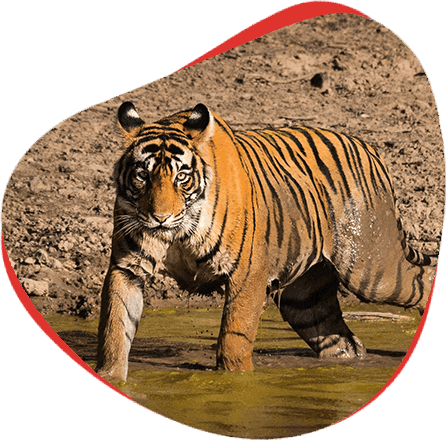
On the way back from the evening safari we encountered a crush of vehicles who had spotted the Mirchani female. She has a new litter of three cubs of about five and a half months old. She dropped out of view and the vehicles left. We stayed and were soon rewarded by her presence. She walked towards our Gypsy, sprayed a tree, came onto the road, sprayed another tree and then went off into her home, the jungle.


This video will be up tomorrow.


The next morning produced one of the most fabulous tiger sightings ever. We encountered the Mirchani female’s two male cubs from her previous litter, two enormous males of about 27 months. When we first saw them they were just sitting and facing the road, but what made the sighting so special is that they began to play tag with one another. One brother would walk a little way, and the other would then come charging after him. The sound that the bulk of a tiger makes when running, makes one not want to be a chital.

I have videos which I have edited and I hope to get these up tomorrow. For some reason, I cannot seem to reduce the size of the edited video.


On our way back we heard the alarm calls of a langur and thus stopped. A sambar then began to bell consistently, and we watched, all eyes towards the direction of the alarm calls. I then heard the American gentleman say, “There’s a tiger . . . no it’s a leopard,” and as we spun round we saw a leopard streak across the road behind our Gypsy, a truly rare sighting for Bandhavgarh.

The next two safaris produced cursory and distant glimpse of the two brothers and a very good jackal sighting.


More from me later.